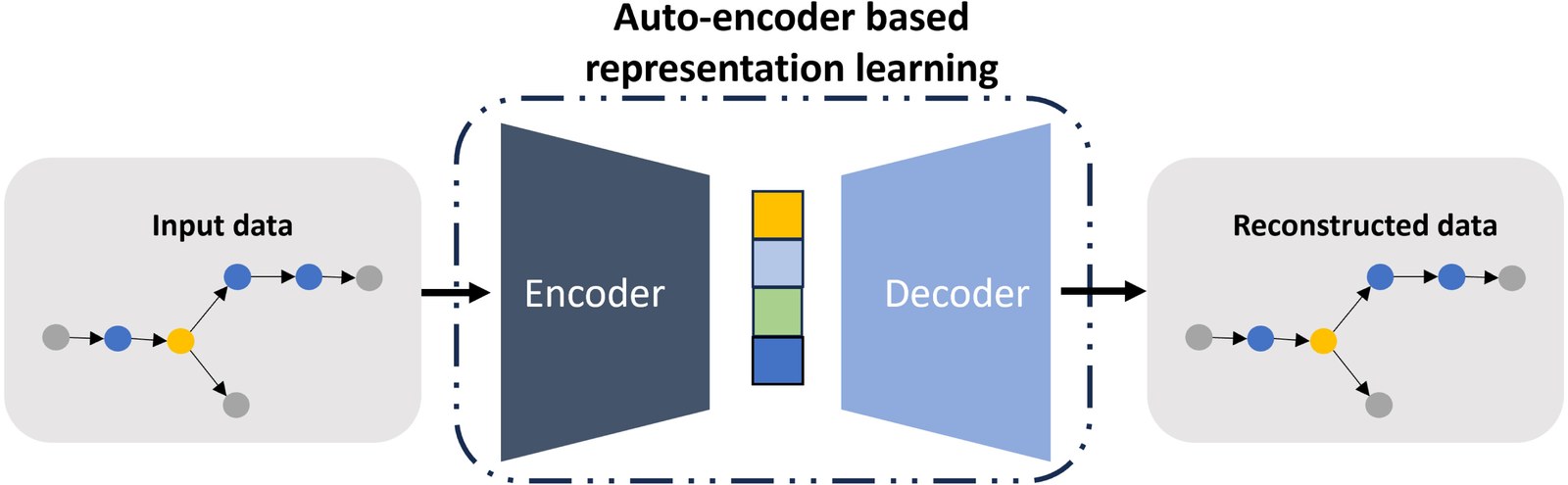
Representation learning for process topologies in Digital Chemical Engineering
Our paper "Representation learning for chemical process topologies using variational autoencoders" by Maximilian F. Theisen, Qinghe Gao and Artur M. Schweidtmann was published open access in Digital Chemical Engineering.
Generative AI could speed up chemical process development, but it needs large amounts of structured process engineering data, which are rarely available. Representation learning helps here: it uses unlabelled data to learn meaningful representations that improve downstream generative AI tasks even when little data is available.
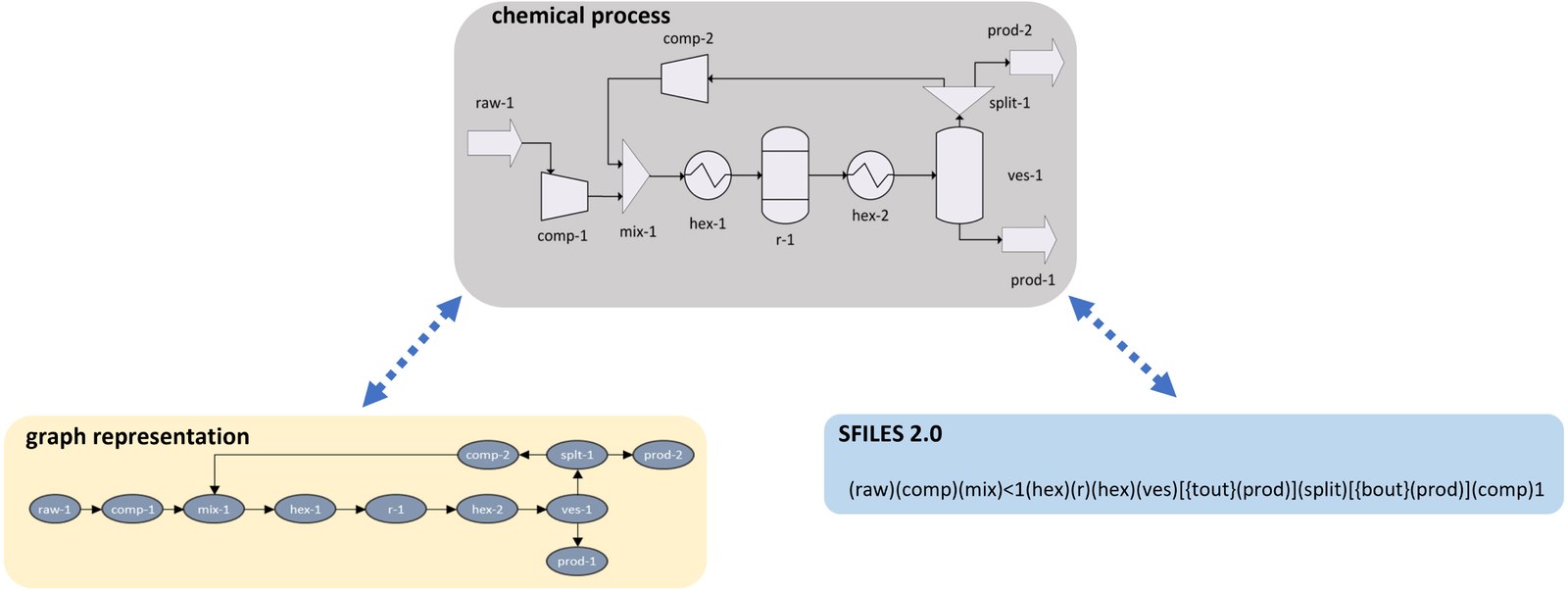
In this work, we learn representations of chemical process topologies (flowsheets) with variational autoencoders (VAEs). Flowsheet topologies can be represented as graphs or as SFILES 2.0 text strings:
A graph neural network encoder maps each process topology to a distribution in a latent space, and a decoder rebuilds the flowsheet graph from that latent embedding, one unit operation at a time:
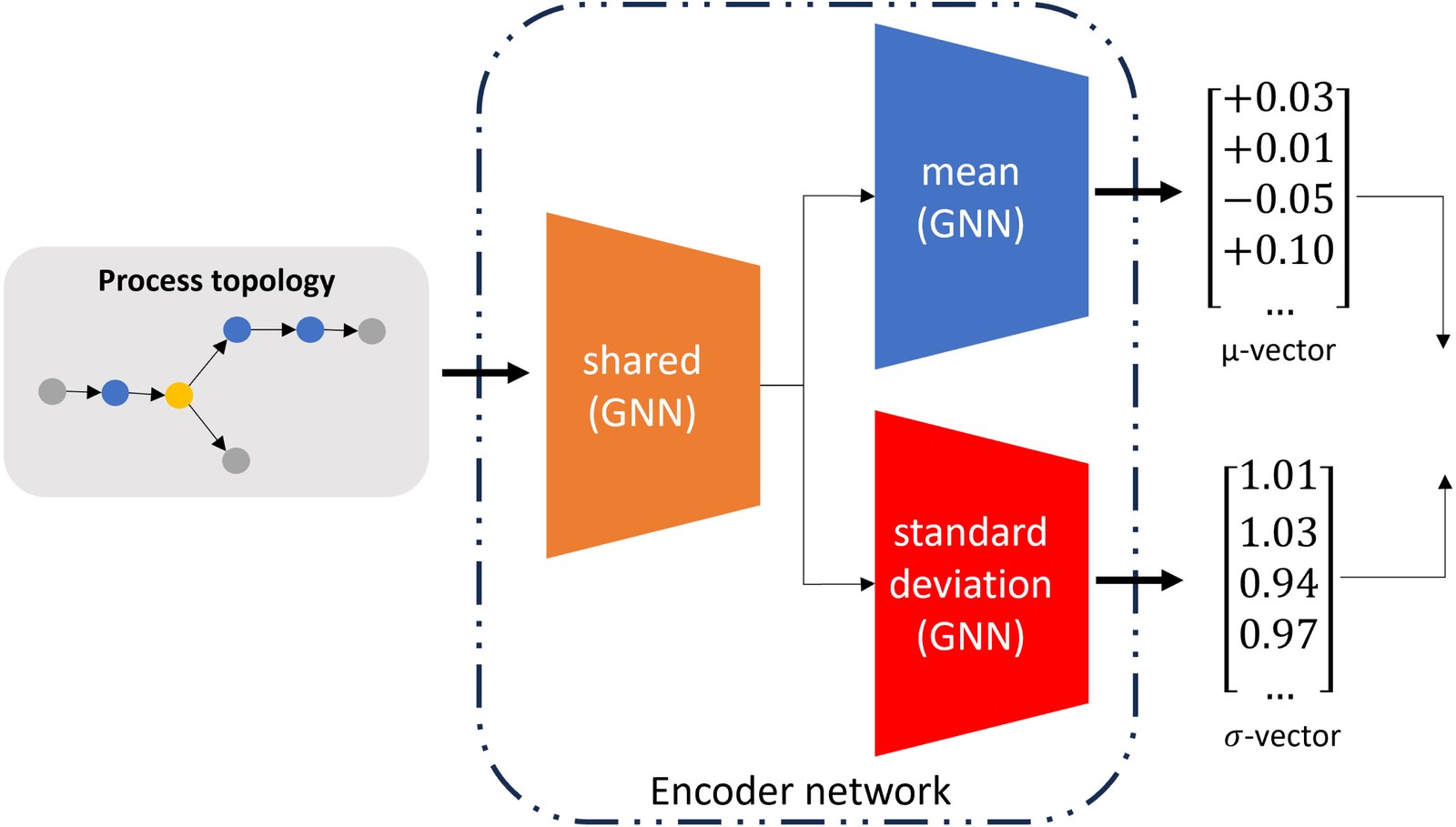
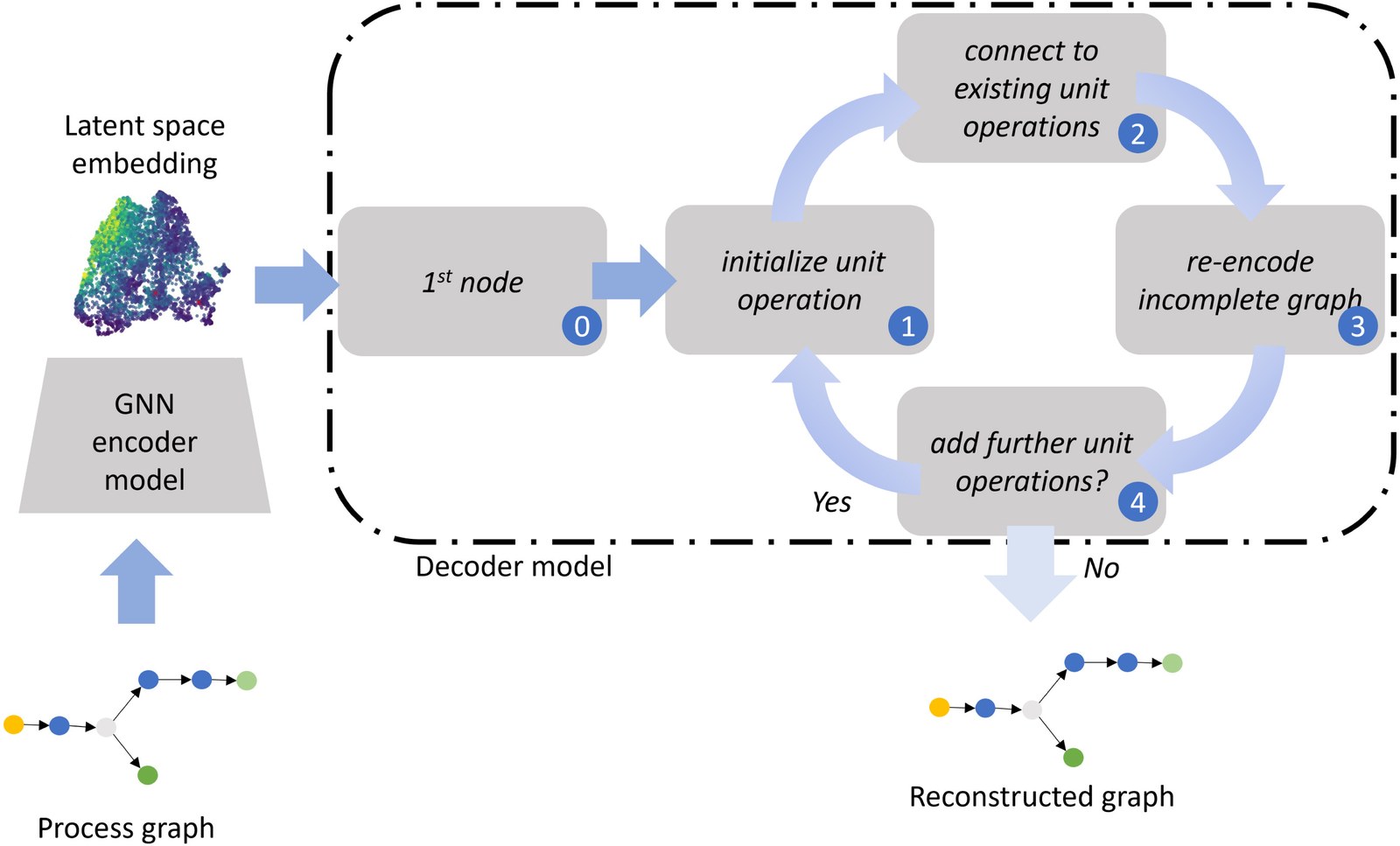
Main points:
- We develop two VAE architectures: a graph-to-sequence VAE and a graph-to-graph VAE.
- The models are pre-trained on 8,000 synthetic flowsheets and then fine-tuned on 730 real flowsheets.
- The VAEs reconstruct flowsheet topologies with an accuracy of up to 42.50% on synthetic and 21.67% on real flowsheets.
- Graph-to-sequence models perform better than graph-to-graph models, while a sequence-to-sequence VAE baseline performs best on our dataset.
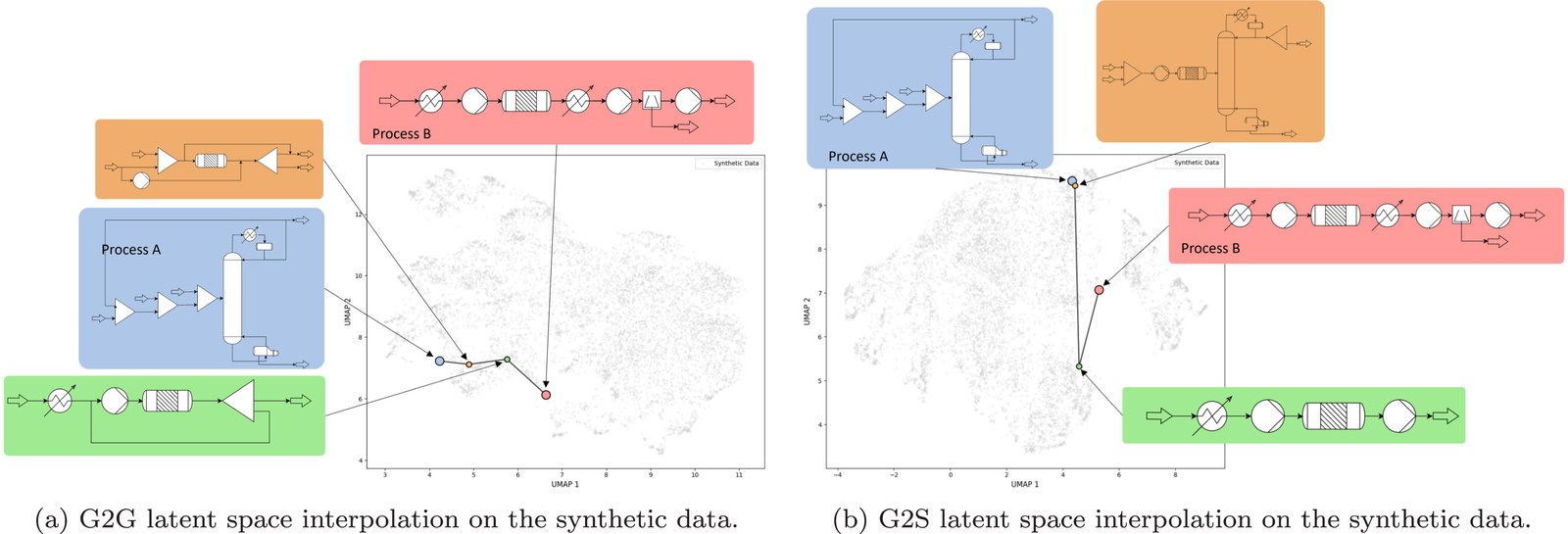
- We visualize the learned latent space and explore the embeddings in a process engineering context.
The work is part of our research on generative AI in chemical process engineering and flowsheet autocompletion.
Paper: M. F. Theisen, Q. Gao, A. M. Schweidtmann (2026). Representation learning for chemical process topologies using variational autoencoders. Digital Chemical Engineering, 21, 100357. https://doi.org/10.1016/j.dche.2026.100357