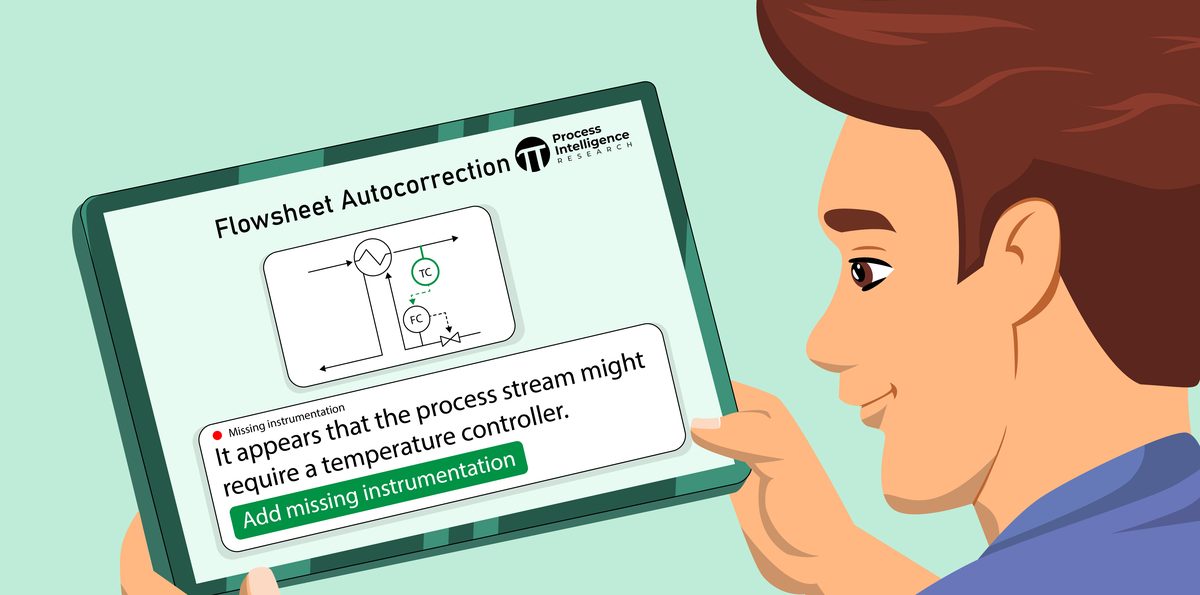
New paper: Generative AI for the autocorrection of utility-system P&IDs
Our paper "A Graph-Based Generative Artificial Intelligence Methodology for Autocorrection of Utility-System P&IDs" by Lukas Schulze Balhorn, Dominik P. Goldstein, Niels Seijsener, Kevin Dao, Ge H. M. Driessen and Artur M. Schweidtmann was published in Chemie Ingenieur Technik.
The review of Piping and Instrumentation Diagrams (P&IDs) is still largely manual, time-consuming and error-prone. The paper treats P&ID correction as a machine translation task: machine-readable DEXPI P&IDs are converted into attributed graphs with pyDEXPI, and the corrected topologies are represented as generalized SFILES sequences.
Based on this representation, the authors adapted the transformer-based Graph-to-SFILES model to utility-system P&IDs and trained it on a synthetic dataset of pairs of erroneous and corrected diagrams. On this benchmark, the model reaches high accuracy and learns error patterns that depend on component attributes. Tests on five industrial DEXPI P&IDs show a gap between synthetic and industrial data, which points to the need for more and more diverse training data.
The work is part of our research on P&ID autocorrection.
Paper: L. Schulze Balhorn, D. P. Goldstein, N. Seijsener, K. Dao, G. H. M. Driessen, A. M. Schweidtmann (2026). A Graph-Based Generative Artificial Intelligence Methodology for Autocorrection of Utility-System P&IDs. Chemie Ingenieur Technik, e70135. https://doi.org/10.1002/cite.70135