Multi-agent systems for chemical engineering
Large language model (LLM)-based multi-agent systems (MASs) are a recent but rapidly evolving technology with the potential to transform chemical engineering by decomposing complex workflows into teams of collaborative agents with specialized knowledge and tools. This review surveys the state-of-the-art of MASs within chemical engineering. While early studies demonstrate promising results, scientific challenges remain, including the design of tailored architectures, integration of heterogeneous data modalities, development of foundation models with domain-specific modalities, and strategies for ensuring transparency, safety, and environmental impact. As a young but fast-moving field, MASs offer exciting opportunities to rethink chemical engineering workflows.
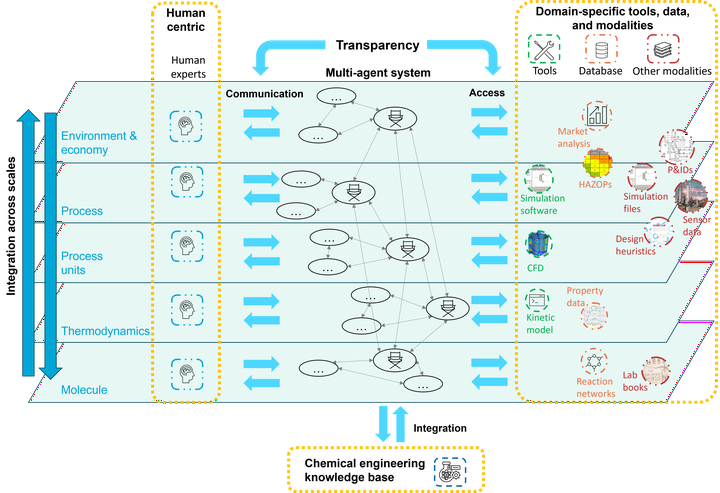
We envision MASs in chemical engineering as interconnected, human-centric collaborators that integrate across different scales, with access to domain-specific tools, databases, and modalities to drive intelligent and transparent decision-making.
Chemical engineering challenges span multiple scales from molecular to plant-wide operations and global supply chains. As illustrated in the figure, MASs offer a natural way to bridge these layers, with agents specializing in specific tasks while coordinating toward shared objectives. This architecture aligns closely with how chemical engineering work is already organized: in teams of experts using specialized tools and information. For example, agents equipped with thermodynamic and kinetic models can explore reaction pathways and materials, accelerating discovery at the molecular level. At the process level, operational agents dynamically run optimization routines, balancing yield, energy efficiency, and safety. Across plant and supply chain scales, agents negotiate schedules, logistics, and inventories in real time, while sustainability-focused agents continuously evaluate environmental and economic performance.
We envision a future where every engineer manages a team of intelligent agents. This paradigm extends existing workflows and empowers engineers in a scalable, intuitive way. At all times, human engineers remain central to this ecosystem. Rather than replacing human expertise, multi-agent systems are designed to support and augment it. This requires agents to communicate in ways that are transparent, interpretable, and aligned with the users, e.g., through natural language, engineering diagrams, modeling code, and experimental procedures.
Realizing this vision depends on agents being well integrated into the chemical engineering domain. This includes interoperability with modeling and simulation tools, access to validated databases, and the ability to interpret diverse data modalities. The goal is not to build generic end-to-end black-box AI systems, but domain-specialized teams of agents that understand and respect the intricacies of their subdomain within chemical engineering. The following subsections outline the key building blocks and developments that are required to realize our vision.